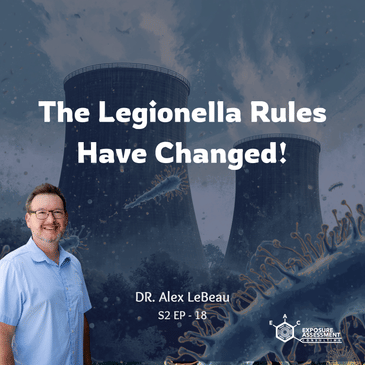
The podcast discusses the occurrence of Legionella and Legionnaires disease outbreaks, the new regulations for cooling towers, and the changes in chlorine disinfectant levels. It explores the impact of these factors on public health and the challenges associated with managing and addressing these issues effectively.
Takeaways
- Legionella and Legionnaires disease outbreaks
- Regulations for cooling towers
- Changes in chlorine disinfectant levels
Chapters
Alex: Hello and welcome to today's edition of the Exposure Scientist Podcast. It's the summertime. It's been hot. And it's the time of year where Legionnelle and Legionnaires disease are beginning to pop their cases up in a number of different places across the country. You've probably seen news stories or articles about them appearing. there's recently as is a notification went out in the July fourth weekend from the New York Department of Health. Which said that there's an outbreak occurring up there. a number of different cases. I think a minimum less I saw was about fifty confirmed cases associated with a number of different buildings. It is that time of year when these things are going to happen. And there have been some changes, positive or otherwise, in in some landscapes. As far as managing those risks associated with Legionella and Legionnaires disease, and finding out the best way to I'll say treat them or address them. sometimes the people making decisions do good things, and sometimes the people making decisions do bad things. So we're gonna cover some of that today. Let's start with the good. I guess we should get the good out of the way. So there is as recently as May 8th, I'm I'm gonna try something new here in the podcast today. If you're watching a video portion of this, we're going to try to share our screen. We're getting we're getting with the new technology of 2026. So this says new Legionella testing regulations for cooling towers going to affect citywide as summer nears. This is from New York City Health. It talks about there are new regulations for cooling towers. it changes the requirement from cleaning the towers from every ninety days to a maximum of thirty-one days. That's interesting. You know, this was brought about in some part in in response to a fast moving outbreak that occurred in 2025, that was evolving so rapidly and there were such changes in the the exposure scenarios that the ninety-day cleaning they theorize Was not sufficient to capture and and maintain and adequately address the presumptive Legionalis source from these cooling towers from the 2025 outbreak. So, in response, in part, from what I understand, was this new citywide cooling tower rule that went into effect. it discusses why they've done it. There are are some still some requirements. for cleaning towers in New York as far as when you bring it up from an off season outage. but this is going to increase the amount of times it is going to be cleaned. Now what are the rules and regulations for cleaning cooling towers and recommendations? Well that that varies. for cooling towers, you know, a good visual observation will at least tell you how the system looks. You know, your testing, your daily testing, your legion, a culture testing will tell you how the system is operating. The cleaning will take it to a new level, but again, it needs to be more than just a performative box checking exercise. It actually needs to be done correctly. And someone needs to verify that it has been done correctly. And see here on the stories I was talking about. New York City announced this about the central Harlem Community cluster of legionnaires diseases disease cases. There are a hundred and eighteen cases of legionnaires disease that they identified. So This is a good thing, I think. We're gonna see. New York's gonna see how it goes. And when New York does stuff, other people may catch on. You know, they're again the first in the country to have this testing or the regulations for cooling towers. Other places have adopted them. These are updates to those changes. I think that's a good thing overall. So let's you know, I'll say let's praise New York when we can on their efforts here now. An interesting thing that was brought to my attention recently, for better or for worse, is and it it's hard to find out when this change occurred. And I I have some information on that. So I'm I'm in I'm in Florida, so Florida, I'll say Florida regulations and rules are important to me. And When I'm looking through or handling matters that are close to home, I see things that make me go, why? Why was this done? When was it changed? What was the scientific rationale for it? And is there support for it? And is it difficult to do? So I'll I'll clue you in. As you probably know, the the The low-hanging fruit for looking for presumptive causative cases, I'll say of travel-associated lesionnaires disease. If someone's staying in a hotel or somewhere else that has amenities, everyone focuses on the spa. They say the spa is likely the primary source of the exposure. It could be true, could not be, because again, as you think about all your exposures occurring throughout your entire trip, that's just one spot along the way. But spa. Care is important. I there's no doubt about it. You know, making sure that you have a clean spot, it's w operating effectively, you're disinfecting it appropriately, cleaning inappropriately, doing everything you need to as far as state regulations or or recommendations. It's a good thing to do, just generally for an operational standpoint. In the state of Florida, I'll share my screen here again for those that are on the video podcast. We'll see how this goes again. The state of Florida you they they issue they're they're weird, they have administrative codes, they issue them in word files. you know, it is what it is. So in the state of Florida, when the Department of Health to come out and regulate or inspect or do anything for a spa or a pool, and I have it highlighted here on the screen, previously they allowed a residual chlorine, I'll say disinfectant. level of two to ten milligrams per liter. You can see here I have it highlighted. Bromine says 1.5 to 10. That's great. Conventional pools, it says 3 to 10, but I'm focusing on spas. 2 to 10. Okay. That that that's some that's some wiggle room. You know, it's it's it's it's hard to get things accurate, especially as we know bathers will impact the amount of disinfectant. their rain can impact it. It rains here all the time. It's hard keeping those chlorine levels normalized. Now, a lot of these places have automatic feeders. but you know, sometimes depending on the amount of change, the amount of bathers, what's going on, it may take a little while for them to catch up. But two to ten is probably a good range. At some point, I say at some point. The state of Florida revised their rules. This says effective six eleven, twenty twenty three. Didn't even see anything about it. The only way I found out about it is someone got tagged on on their changes. State of Florida has now changed to say where water and recreation attracts pools, interactive fountains, two to three, two milligrams per liter. To five milligrams per liter for spa type pools. From now on went from two to ten, from two to five. Can you imagine having to keep a pool or a spa in constant compliance with a three a a three ppm change level in there? That that's a very small amount. I mean, you could maybe you got ten bathers a hop in there. That PPM is going to go psh, and then the system's gonna overcorrect, and then when they get out, it's gonna go sky high. It's a very small number. I don't know what the scientific justification was for this change. I don't know how many people are aware of this change, but I came across somebody who was getting tagged over and over because they had more or higher amounts than what was recommended, or or from the administrative code. I think that's important. So now you went down from two this isn't Florida again. You went from two to ten PPM, now down to two to five PPM. And you're like, all right, well, that's a very small number. So is there scientific justification for it? Well, that's a good question. So there are other I'll say if you are familiar with a few things that are published in the literature, one that I'll go to and th this is relevant from I'll say cruise ships that dock here. I don't know if you're If anyone is familiar with the sanitation program, the vessel sanitation program. They have requirements that they talked about on amount of residual chlorine that's that's necessary. that's put up by CDC and there has to be compliance. So, what does the VSP say? VSP says, well, swimming pools and spas. Look, they say for whirlpole and spa pole has to be greater than three and less than ten of free chlorine. All right. Well, CDC recognizes greater than three and less than ten. It's a much wider range than now the two to five that Florida has. Is anyone, I don't know if anyone is familiar with the other program. the model health code program. If you are unfamiliar with that, I think it's something that you should look up, take a look at. The model CDC model health program says how much for spas free chlorine minimum of three ppm of of chlorine in there. It doesn't say a maximum, but there is there is a a a minimum recommendation, which Florida's they ha they have two is a minimum. The the model health code recommends three. I think it's very hard to maintain that level on an ongoing basis. Interestingly, and the best thing is now the state of Florida, if you're familiar, they have a Legionella I can also say guidance document that was published in 2014. But if you go to that guidance document, essentially it says, Hey, you know what? You should maintain your spot two to ten PPM. So if you're following something for recommendations for Legionella guidance and you're following what the state of Florida previously said to manage Legionella in your system, you would be out of compliance with the current health department code that says it has to be two to five, even though you're still trying to manage your Legionella in a way that was previously shown to be scientifically defensible. This gets hard. What is the recommendation? That's up to the client what they're willing to do. You know, I I I think it's I think it's justifiable if you're having an inspector, you're continually getting tagged for it. Provide the inspector scientific rationale, see if the offer of some kind of variance. You know, you're maintaining it as part of your maybe your facility, maybe your water management plane was written on a two to ten basis for your spa. And now you've got to go down to two to five. It may not be functionally rational to do that. It may not be physically possible to do that for your system. I don't know what kind of systems everyone has set up. You know, if they have automatic feeders, likely most of them do, but there may be subtle corrections that may not be able to be fully articulated within the system and the system may be all over the place because they're keeping such a small window now of chlorine. I don't know where this came from. I tried to look up some background information. If anyone has any information on why this change was made. What the scientific rationale was, and who made the decision to do this? Was it someone from the Department of Health that said, this is what we think is the best thing to do? Was it, you know, people in elected positions that says, well, you know, the this is this this seems this seems good. You know, again, good things and bad things. Good things, they're cleaning cooling towers more. Hopefully it's gonna reduce lesionnaires disease. Bad things, they've reduced the amount of chlorine, the maximum amount of chlorine in spas. And there may be more cases or more alleging more cases of Legionella in spas because yeah, maybe it was they'll worry about chemical burns. I don't know. I guess it's all it's like many things with with water temperatures, you gotta worry about scalding. But if you keep it with you know, under 120, 130 degrees, you're keeping it in the zone that Legionella likes to grow. I'd love to hear everyone's opinions. I'd love to get some feedback. Have you on, have a chat. If you know anything about why the change was made, the state of Florida level, health department level, or state legislative level, let me know. I'm happy to have a conversation because whenever you make a change, it's gonna take a little time to see the effects of it. And I think based on when I see this in twenty twenty three and now we're in twenty twenty six and I see a number of issues with spas lately, I think we're seeing the effects now. Hope I'm wrong, but I don't think this is a change for good. Let me know your thoughts. Hope you enjoyed today's episode of the Exposure Scientist Podcast and I look forward to speaking with you again soon. Thank you so much.