We would love to hear what you think?
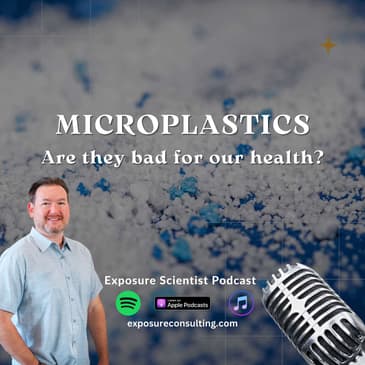
Welcome to The Exposure Scientist podcast, where we dive into the everyday hazards we encounter and how they may impact our health. In today's episode, Dr. Alex LeBeau discusses the hot topic of microplastics. He explains what microplastics are, how we may be exposed to them, and the scientific studies surrounding their health impacts. Dr. LeBeau breaks down the concerns and the current lack of conclusive evidence on the human health risks posed by microplastics. He also delves into potential solutions and considerations for minimizing exposure. Join us as we explore this important conversation on microplastics and their relevance to our daily lives.
Contact Dr. LeBeau Exposure Scientist
Contact Dr. Alex LeBeau at Exposure Consulting for exposure litigation support or Exposure Science Consulting.
[00:00:00] You might not realize it, but we are exposed to dozens of hazards every day. Can any of these hazards negatively impact your health? Definitely this is the Exposure Scientist podcast. My name is Alex LeBeau and here.
[00:00:15] We answer your questions and concerns on what you may be exposed to every day. Welcome to the Exposure Scientist podcast. The views expressed in this podcast may not be those of the host or management. This podcast is for informational purposes only and should not be considered health advice.
[00:00:34] It is recommended that you consult the Exposure Scientist to discuss the particulars of your exposure scenario. Hello and welcome to today's episode of the Exposure Scientist podcast. My name is Alex LeBeau and today I'd like to talk to you about a subject that has received
[00:00:50] attention as of late over the past few months. There's been increasing amount of studies, scientific studies and news articles relating to the presence of microplastics. These microplastics a lot of focus has been in food items but there's been five focus of microplastics in water as well as food.
[00:01:11] So what are microplastics? How are we being exposed? Are we being exposed to microplastics? What do the scientific articles actually mean that are being published? So first of all, let's start off with what microplastics are. Typically microplastics are plastics that have a millimeter size range EPA identifies microplastics.
[00:01:38] I think ranging from one nanometer up to five millimeters. Actually, interestingly, what is available in definition from EPA is anything that is under one nanometer is actually classified as a nanoplastic, which has a different surface to area ratio. Particles have a different surface to area ratio than microplastics.
[00:02:06] And that's a long discussion to talk about what exposures may be and how they interact with their environment. So how are we being exposed to microplastics? Or what are a lot of the studies saying recently that it exposures to microplastics?
[00:02:21] They hypothesize in the studies of focused on simulations of cutting activities, whether it's cutting boards or using any kind of plastic utensils, plastic specialists, plastic spoons, etc. Anything that has the potential to dislodge from an entrain matrix like those utensils or cutting board.
[00:02:45] The thought is that humans are exposed from the dislodging of those materials in the food that they're eating. So what are typical exposure routes for humans? Typical exposure routes are ingestion, eating, inhalation, breathing, and dermal exposure or something touching the skin.
[00:03:07] So the route of exposure is important when we're looking at microplastics, so the main concern from microplastics and plastics are small plastics that we're worried about is something that's oral ingestion. That's what a lot of the studies recently have focused on.
[00:03:26] And even EPA has a webpage on microplastic research in what it means. So what are some of the concerns? What are we looking at? We're looking at polyethylene, polypropylene cutting plastics that may come dislodge polystyrene. Anything that can be ingested that is small.
[00:03:54] What are the impacts of human health from exposures to these microplastics? A lot of studies are saying that there is potential that is going to be from exposure to these microplastics,
[00:04:07] but I want you to take a look at the studies and see if they actually come to conclusions. I'm a majority of the studies have no conclusion on microplastics in human health risk. Some of them don't even attempt to evaluate it.
[00:04:22] They just publish the potential for human health impacts. Some of them have actually used biological models, which include by cells in a plate or petri dish. To see how cells are going to interact with the microplastics, but again, as in the course, it's important.
[00:04:39] At least in this context that cells obviously are taken out of the human context and component. That's not how we interact with things or bodies are advanced complex mechanisms.
[00:04:50] So it's important that when you're looking at the models, they're being used in these studies, the methods that are being used, Are they actual human health qualifications?
[00:05:03] Or are they simulating what could happen with exposures are because it's important as I like to do often exposure and dose are two different things. Exposure is the opportunity to come in contact with the substance and internalize it into the body. It's the opportunity.
[00:05:22] Exdoses the actual amount of substance that interacts with the body and has the potential to dose is what gets into the body has the potential to interact with biological systems.
[00:05:36] So what is going on when it gets into the body? Is it actually interacting with biological systems in a way that's going to be harmful? What is the bioavailability of this material? That means how much is it available to interact with our body?
[00:06:00] The studies don't really get into that. They kind of say, well, it's inside us. It must be doing something to us but it doesn't quantify with the human health risks are.
[00:06:12] Again, a lot of them are using models, a lot of them are using cellular uptake kind of culture, aparatisies or methods to quantify human health risk. But there is very little data that actually show that microplastics are causing human health risk issues.
[00:06:32] We may be exposed to them, but if there is no biological interactions, then it's going to just pass through our digestive system on digested, on interacted, not interacting with our bodies and not causing any real health. What are the health effects?
[00:06:53] The health effects between the different sizes. Remember earlier I said microplastics and nanoplastics have specific definitions, specific surface to area ratios. Are they breaking down what the different actual size characteristics are to see if there is any maybe interaction with nanoplastics that may be happening versus microplastics?
[00:07:17] There is important in distinction between two and as important to understand what may be going on with that. Exposure science covers a broad subject area, including toxicology and duster-ohygine and risk assessment.
[00:07:32] From occupational community or environmental exposure, exposure scientists apply scientific methodologies to understand exposure risks in applied controls when necessary.
[00:07:43] We at exposure assessment consulting have this expertise. Please reach out to us at info at exposureconsulting.com for a free 15 minute consultation to discuss the specifics of your exposure scenario.
[00:07:58] Is this something to be concerned about from a human health aspect when you're cooking in your kitchen, when you're grilling or what have you or when you're going on to eat? I don't think the data right now support that microplastics are a human health risk.
[00:08:16] We use plastic cutting boards here at home, but we also use wood cutting boards.
[00:08:21] You know, I haven't changed based on the data's been presented because I haven't seen anything from a scientific standpoint that's going to make me weigh the evidence and say that there's a human health risk.
[00:08:31] However, are there other solutions if you want to substitute those materials out of your lifestyle? There are, of course, when we're in duster hygienists, we look at the hierarchy of controls. How we can eliminate something, we can substitute it using engineering controls, administrative controls.
[00:08:51] How can we substitute plastic for something else that's easy to do? There are wood cutting boards out there in natural wood boards. Some of them you have to take into consideration what the material is.
[00:09:09] For example, USDA recommends use a bamboo cutting board because they're a harder denser wood and they're less porous. However, other wood cutting boards that are out there that may be more porous that are harder to clean and harder to get it back to you.
[00:09:24] There's surfaces may be such that there are so many divots and crevices that bacteria may grow on those boards even after you've washed them. So if you're going to want to eliminate plastic cookware out of your life cutting boards spoons, spatulas, utensils, etc. Look at what you're using.
[00:09:50] Is it something that's going to introduce another health hazard into your life? Whenever you make a change into what aspect of what you're doing, you have to understand the down stream effects of pancure.
[00:10:03] If you're going to take plastic cutting boards out of your life and use wood cutting boards, make sure it's a wood cutting board that is not going to allow bacteria to grow.
[00:10:16] Because of the nature of the wood, because of the design of the wood, you know, is it one solid piece of wood? Is there a lot of pieces glued together or are the joints tight?
[00:10:29] These are all things that you have to consider from a human health risk when you're looking at it. So you should be be concerned when you go out to eat.
[00:10:41] You know, there's been microplastics, again I'm using the term in a general way, in microplastic here is encompassing the endoplastics. You know, there have been these microplastics that have been identified in bodies of water.
[00:10:55] EPA's even looking into the pollution from microplastic into bodies of water, whether it's impacting aquatic life or human health risk. You know, what are the risks that we're facing? It's like anything.
[00:11:13] The dose makes the poison but the dose also comes along with how much of that is interacting in the body. If it is oral ingestion based on the nature of the plastic, it may not interact with our bodies, watch it all.
[00:11:29] You know, if it's going to go through our gut, there I had professors in college that said, you know, the way some people view what goes into the mouth and comes out of the body is outside the body.
[00:11:45] There's a closed system that goes through the mouth, the stomach, the intestines, etc. The colon and comes out and that is outside the body because it's not getting into the body.
[00:11:56] And I was taking up by the intestines, taking up into the body from oral ingestion is what gets inside the body. Does any of the microplastics leave the mesenteric system, the system where you're eating and generating excrement?
[00:12:17] Does that do anything to get the microplastics from that space into any body compartments? I don't think that data are supportive of that right now.
[00:12:29] But so take that in the consideration when you're worried about microplastics, when you're worried about how things are being cut or being used on plastic cutting boards, plastic potentials etc.
[00:12:45] We're going to go into this a little more a little more detail. Probably pull up some of these studies here and the future just kind of dissect them a little more, but the overall broad scope is that right now based on at least the information that's presented I don't think microplastics are human health risk.
[00:13:02] We'll more information potentially come out that are using better assessment models themselves or something of that it's potential. But I think the science right now does not support a human health risk from exposure to the microplastics.
[00:13:15] I want to get this out there because you know, I was recently interviewed for a new story on this. That they wanted to understand what the toxicological significance was of microplastics and I don't think that that is supportive of any human health risk but we will see.
[00:13:32] I want to start this conversation. This is all about starting conversations. If you have information that you view is differing from what I've presented please feel free reach out send it to me. I'm happy to have a conversation because the whole point of our podcast is to inform all the professionals.
[00:13:49] But people in the community about what information they're seeing versus what information is actually. Scientifically supported so I appreciate you joining us for today's podcast on microplastics again.
[00:14:06] We're going to have additional conversations about this evaluating studies, but I think this is a good place for us to start this conversation. Thank you so much for joining us. We hope you enjoy today's episode and look forward to speaking with you soon. Thank you.